Checking in on America(ns)
Impressions from the field
Hi, gang! The newsletter has been a bit quiet because I’ve been on the road for the last month or so, having come back to the US for a little while to attend to some personal matters. I’ve only recently arrived on the East Coast after spending some time in the Pacific Northwest and then driving across the country (a 5-day journey of 9-14 hour driving days…), so I’m just now starting to catch my breath while trying to catch up on some backlogged work.
I’ve got a few other things in the pipeline, including an article about geopolitics that I originally intended for The Checkpoint, but which has grown long enough that I think it’s eventually going to end up over on my Medium site. Today, though, I just wanted to check in and write a bit about some of my impressions of what I’ve encountered when talking with people in America about Ukraine over the last month.
The mood in the US right now, for obvious reasons, feels both incredibly tense and incredibly muddled vis-a-vis Ukraine. The Trump regime’s loud betrayal of Kyiv, coupled with generally naive and uninformed coverage in the news and the endless avalanche of Russian propaganda on social media, has, from what I have seen, left even many well-meaning people who support Ukraine in a state of confusion and paralysis. Over and over, I’ve been asked: “So what’s really going on over there?”, reflecting, I think, a certain suspicion that, while Trump may be lying through his teeth about the war, the mainstream media, for its part, is doing a terrible job in its reporting.
My various interlocutors—mostly people who I didn’t previously know and who have ranged from retirees to college students and people across the political spectrum—have often seemed taken aback when I tell them that, in my opinion, the war is not going to end any time soon, that Trump has no ability to end the conflict (and, moreover, that he’s thrown his lot in with Russia and that the “peace” he boasts about will be decided, in classic imperial fashion, between Washington and Moscow), and that Ukrainians are nevertheless determined to resist until they achieve a just peace.
At times, I’ve even detected a sort of “both-siderism” creeping into the discussion, with people asking me why “Zelensky doesn’t want peace” or mentioning things like “people being forcibly conscripted right off the streets” as evidence that “there are no good guys in this war.” Ukrainians, by and large, are not understood as people so much as they are treated as characters in a drama that people are kind of getting tired of hearing about.

It feels, moreover, like a lot of ordinary Americans have more or less accepted Trump’s framing of the war, even if they are otherwise suspicious of or hostile to Trump himself and are otherwise inclined to support the Ukrainian cause. I don’t think the issue is so much that people don’t support Ukraine, it’s that they don’t know how to think about Ukraine anymore—they don’t know what’s true anymore, and, combined with the predictable decline in interest in the war (a casaulty of the attention economy), folks have retreated into quiescence. They may indeed support Ukraine as a point of personal morality, but public interest has waned, the flags have come down (I’ve only seen one or two of them here and there in the last month), and people are more preoccupied, at home, with whatever Trump is doing and, abroad, with Israel/Palestine abroad.
When I’ve spoken to more openly conservative people who voted for Trump and told them that I’ve just returned to the US from Kyiv, the discussions have been uniformly brief and anodyne. There’s simply no interest from that quarter in discussing Ukraine at all: not one person I’ve spoken to has asked any follow-up questions about the war nor offered any thoughts or opinions about it whatsoever.
There are, I suppose, various reasons for this—in some cases, folks may just want to avoid giving offense because they have different beliefs; in others, I suspect, it’s because people don’t want to get into a debate with someone who knows more about it than they do; or, perhaps, they simply don’t want to deal with the cognitive dissonance that would inevitably arise when they’re exposed to information that contradicts what Trump and right-wing media are telling them. In any case, the brash and cruel reactions that I’ve come to expect from MAGA people on social media have been entirely absent from my interactions with MAGA supporters in person, who seem more interested in changing the subject than anything else. Maybe it’s just harder to be callous and bloodthirsty about Ukrainian suffering when you’re face to face with someone who’s been there.
My interactions with younger people, meanwhile, have been more disappointing than those with older people. The Gen-Z people I’ve talked to have, by and large, been almost entirely indifferent to Ukraine, and remain far more interested in what is happening in Palestine (although, ironically, their support looks an awful lot like how well-meaning Boomers reacted to the invasion of Ukraine: a strong sense of solidarity with the victims combined with a near-total lack of anything more than superficial knowledge about the historical or geographical context in which the conflict is occurring).
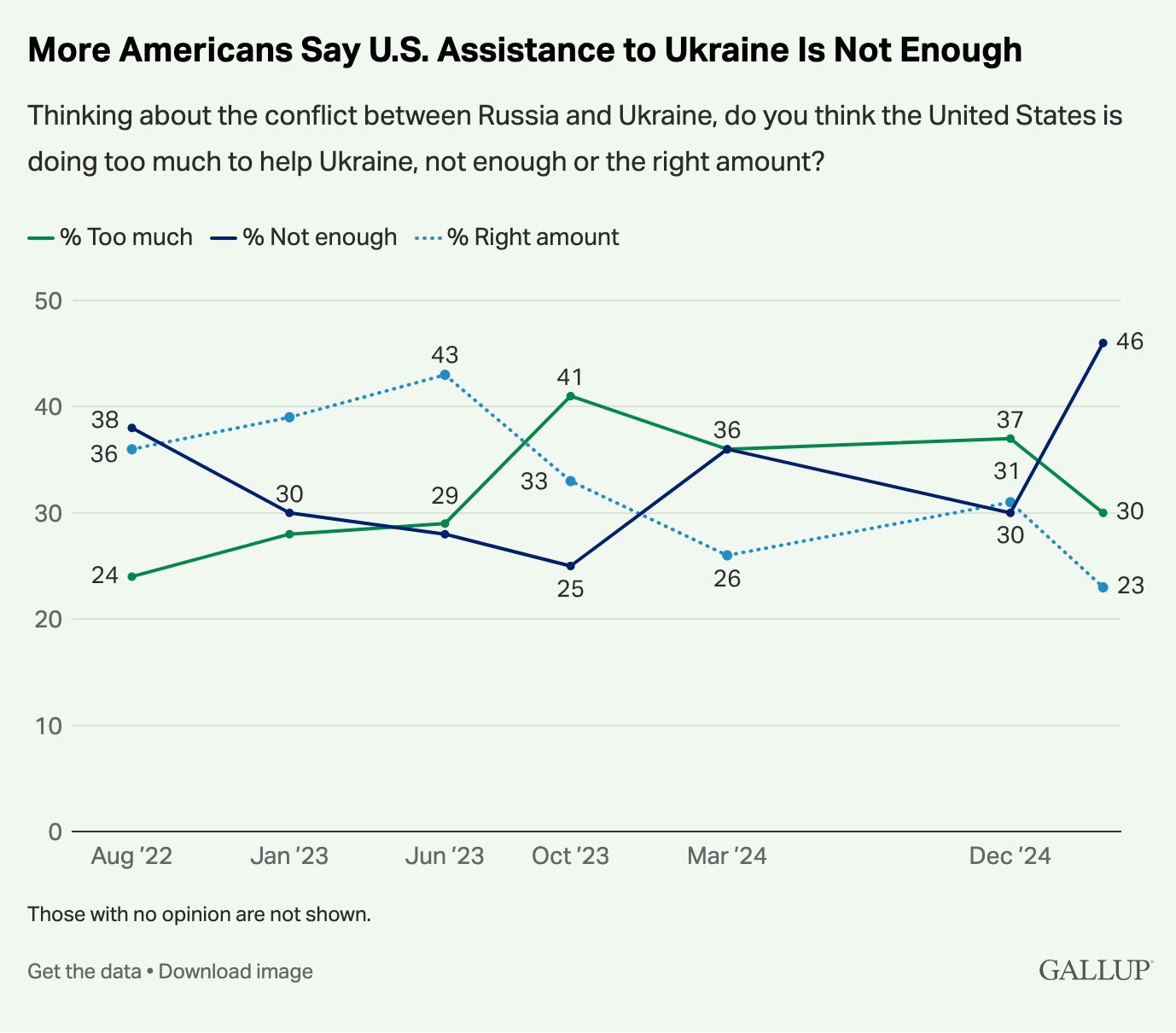
In any case, it is readily apparent to me that Ukraine is far from the minds of most of the Americans that I’ve spoken with since getting back. It is important to note here that this does not necessarily translate to a belief that the United States should abandon Ukraine—in fact, support among ordinary Americans is at an all-time high: according to a Gallup poll released in May 2025, more Americans believe the United States is not doing enough to help Ukraine than at any other time since the beginning of Russia’s full-scale invasion.
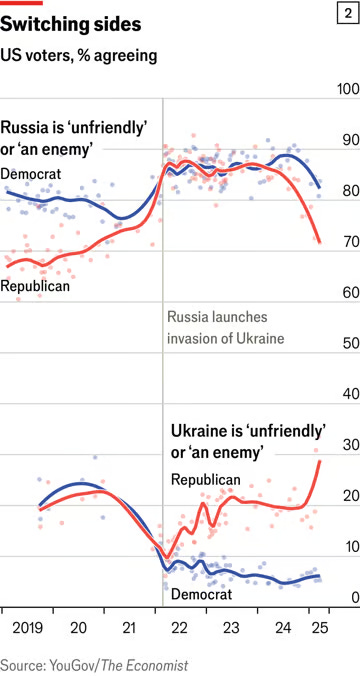
Not surprisingly, there is also a striking divergence between Republicans and Democrats on whether Ukraine is an “unfriendly” country, with a sharp increase in anti-Ukraine sentiment among Republicans since late 2024, mirroring a similar spike after Russia’s full-scale invasion in February 2022.
This mirrors similar spikes in Republican antipathy towards both Canada and the European Union at the same time, suggesting (and I don’t think my interpretation here is particularly controversial) that these dynamics are being driven by propaganda and obedience to Trump, rather than any organic trends in MAGA thought.
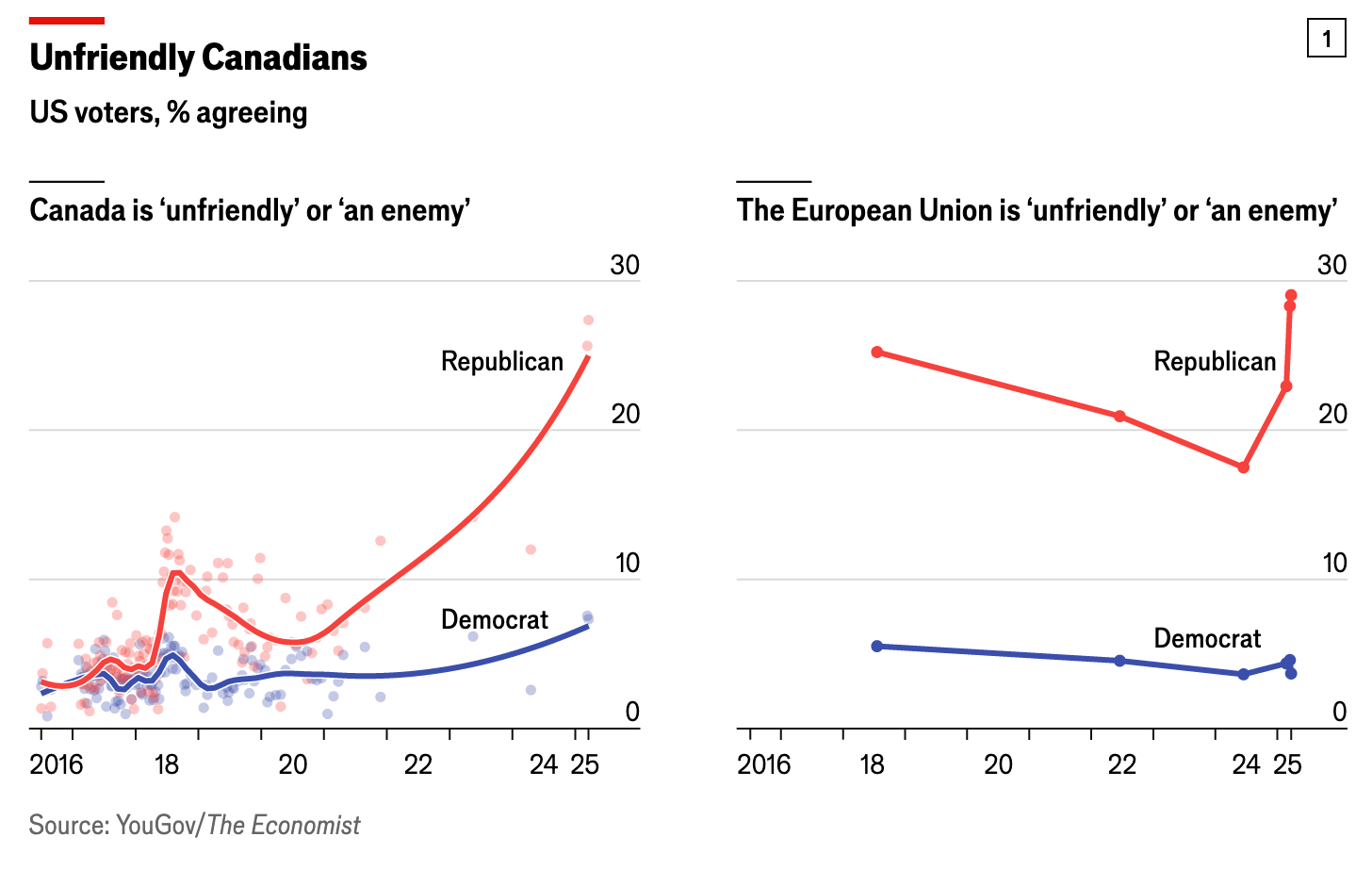
More worrisome, in my view, is the sharp downturn in the number of Democrats who see Russia as an “unfriendly” or “enemy” country. Unlike in the cases of Canada and the European Union, attitudes among Democrats toward Russia seem to closely mirror those of Republicans, with similar (though slightly less pronounced) shifts away from viewing Russia as an enemy happening at the same time. By contrast, anti-Canadian and anti-EU sentiment among Democrats has risen moderately over the years, but it is nowhere near as pronounced as among Republicans.
What this suggests to me is that my (admittedly anecdotal) impressions of the interactions I’ve had with people are not too far off the mark. Support for Ukraine among liberals who already supported Ukraine hasn’t changed all that much, but, as I mentioned before, it feels like people have largely accepted Trump’s narrative about “peace negotiations.” Buffeted by social media propaganda and ill-served by uninformed, shallow, and uncritical mainstream media coverage, even many Americans who otherwise stand with Ukraine have come to believe that Russia is or should be a “partner” in the peace process. Unfortunately, I don’t expect this trend to reverse itself any time soon.
Americans, then, are woefully ill-served by the mainstream media, which simply does not cover what is happening in Ukraine in a nuanced or informed way, especially on television. This means that Ukraine is only really talked about in the media when Russia has committed some new atrocity or in the context of a report about something Trump or his toadies have said or done. And because these reports are usually superficial and uncritical, they lack crucial context or understanding and implicitly privilege Trumpian narratives.
As for what can be done about this, I must say that I am at a loss. Little can be done to alter how the mainstream media works, and it’s my sense that, as Trump continues to punish news agencies that he views as unfriendly or disloyal, the situation will only get worse as editors and reporters chase “access.” Meanwhile, pro-Ukrainian voices on social media simply lack the power and financial support that funds Russian propaganda operations, leading to a situation in which blatant disinformation garners massive engagement and drives the narrative. And while lobbying efforts, including the biannual Ukraine Action Summits in Washington, DC, continue, I’ll confess to being skeptical about the prospects of convincing the majority of Republican lawmakers, whose support is simply a prerequisite to passing any Ukraine aid whatsoever, to break with Trump in any meaningful way.
Ultimately, and quotidian as it may be, I’ve found the best way to communicate with people about Ukraine is to talk informally and in person. While interest and engagement have waned, the dynamics of public opinion that I discussed earlier, which (in my view) are clearly happening in reaction to what Trump is doing and saying, suggest that people are, in fact, still paying attention. The problem, as I said before, is that people don’t really know what or how to think about Ukraine, because their sources of information are, by and large, rubbish, or worse.
Obviously, first-hand experience is particularly valuable in this, and both veterans who have fought in Ukraine and volunteers who have gone to Ukraine and seen the war for themselves have a special role to play, since interlocutors are far more likely to lend credence to the arguments of someone who’s actually been there. But I think that anyone who’s able to talk about Ukraine, Russia, and the war in an informed way (and this is crucial) will have an edge over both the shallow mainstream media coverage and the online propaganda, which trucks in bug-eyed sensationalism and cruelty. Many of us, even those who’ve never been there, nevertheless have friends in Ukraine, either soldiers or civilians, whose experiences we can relate, thereby humanizing and personalizing discussions of something that often comes to Americans in the form of pronouncements and bland reporting on something happening very far away.
This sort of thing may feel, ultimately, a bit trivial: Trump and his cronies are in power, and we’ve got virtually no means of affecting their decision-making. But, while talking to people is probably not going to produce some groundswell of support that will force the Trump regime to change course, I am nevertheless convinced that, while Ukraine is simply not at the forefront of Americans’ minds or top on their list of concerns, a great many of them are not entirely indifferent.
So, despite my general unease with the question “so, what’s really going on over there?”, I think it’s nevertheless worth engaging with in good faith. Not everyone will be receptive, and not everyone is going to be persuaded if they’re not already on the team, as it were, but, having been back stateside for a few weeks now, I do think there’s real value in checking in with our fellow Americans and reminding them that there’s a world outside their social media bubbles and that what they’re seeing on the news isn’t necessarily doing a commendable job of keeping them informed about that world.